06 September 2017

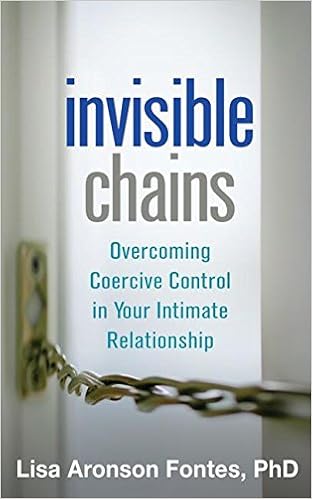
Not a Book Review: Invisible Chains

I read a lot of books, but I rarely have time or incentive to write much about them, so I don't know if this will be the only NaBR post or not...

Recently, I was confronted by an acquaintance of mine over some family trouble one of his children was having. One of the things he said to me was that people talking about it were "contributing to the abuse" of his child. When I asked for his definition of abuse, he didn't provide one, but pointed me toward the book Invisible Chains: Overcoming Coercive Control in Your Intimate Relationships by Dr. Lisa Aronson Fontes, PhD. He said someone had labelled the type of abuse that his child was suffering from "coercive control"and that this was the book this person had used.

So I read it. Not to disprove or argue with anyone, but because I wanted a healthy mental state and a God-honoring marriage for his child, and up to this point, there were some things I'd seen and read from both him and his child that I found troubling. If the book was a solid piece of work, so much the better.

This isn't intended to be a comprehensive review. It's mainly my thoughts on its topic, how it addresses that topic, and specifically, my thoughts about what value it might have for anyone having difficulties within their marriage.

I'll start with a few caveats.
  • When I heard the term "coercive control" I thought of it being the use of various tactics (mental, physical, emotional) to manipulate one's partner into behaving how one wished. I'd agree that this is a bad thing; it shows a lack of respect (at a minimum) for one's partner.
  • This post isn't about a specific person or relationship. It's about the book and how I think it would be used.
  • I'm not trained in therapy and I haven't even done extensive personal study on it, so there could be benefit that I'm missing. Nonetheless, I believe the main thrust of my critique is relevant.
Overall, my main concern is that a significant subjective component plays into identifying whether coercive control applies to a given relationship. Many examples demonstrating a range of potentially abusive behaviors are included, but the book itself doesn't say they are automatically abusive. I am afraid that it would be easy for an individual going through a difficult relationship or suffering from other emotional issues to read themselves into this condition. Unless a trained, objective observer (like a qualified therapist) were the one to make the diagnosis, I would be hesitant to act upon the strong suggestions this book made for dealing with the abuse.

The book doesn't give a very clear, definition of "coercive control" that could be used by the reader independent of a particular individual or relationship. In fact, it states that "[n]o single act defines coercive control." (p.39)  The closest it comes to a definition is to say that one who is in a coercive relationship will feel trapped, isolated, and fearful. Which is probably true, but not terribly helpful in any discussion. Without a clear definition, it's hard to speak clearly on the topic and make sure that everyone is talking about the same thing. It's always hard to speak about an emotional topic in a respectful and useful way, even when abuse isn't a question. When it's been raised, it becomes almost impossible, especially when there isn't a clear definition, because there is no way to refute accusations of contributing to the abuse.

For example, the line it draws between abusive "controlling" behavior and non-abusive "bossy" behavior is completely subjective:
On the other hand, not every man who is “bossy” is guilty of employing coercive control. There are many degrees of bossiness. But if the woman feels actual fear—if she feels she must respond to his demands or else—then she is probably a victim of coercive control. (p. 40)
I'm sure that fear will be present in any sort of abusive relationship, but framing things as this book does makes the emotions of one person the definitive proof that behavior of another person is abusive. If they feel fearful, action A is abusive. If no fear is felt, action A is not abusive.

Labelling someone an abuser based on the litmus test of someone else's feelings seems rife for, well, abuse. Especially as one reads the sections describing the sort of demands and conditions one should place on an abuser in order to evaluate whether he or she has really changed.

There are other, lesser issues that I could point out, but it's the lack of clarity and related potential for harm from misuse that concerns me most. I would strongly encourage anyone who reads the book and believes they may be in such a situation to tread softly. Be open to the possibility, whether or not you are in a coercive relationship, that your perspective may be skewed or faulty. Get a second opinion from someone not vested in your life, preferably someone with training as a therapist.

07 July 2015

Doctrine Matters, or The Homosexual Chip on the Church's Shoulder

With the recent SCOTUS ruling on gay marriage, there's been a lot in the news and social media about homosexuality and equality, and the memes about hypocrisy and homophobia in the church have been flying. I have not been impressed by the theological or religious arguments by the homosexual apologists, but the attention has made me consider a phenomenon from a few years back that I think makes understandable the charge of homophobia that's so often leveled at anyone claiming to take the Bible seriously in a conservative way.

Before I start, a couple of caveats:
  • I'm not saying there is a particular animus toward homosexuality on the part of any specific Christian or Christian group. I believe one can and should accurately hold to a biblical understanding of the sinfulness of something without hating (corporately or individually) those who commit that sin. Rather, I'm going to be speaking about a trend within the church and specifically, how that trend could be reasonably perceived.
  • I think the description of homosexuality as sin within Scripture are pretty clear in both Old and New Testament. Getting into whether a particular civil punishment for the behavior remains valid is a different conversation outside the scope of this post.
  • Similarly, I'm talking about acceptance of homosexuality as a legitimate part of a Christian's sanctified life. I'm not talking about a believer who sins, repents, and seeks forgiveness under the blood of Christ, but rather, the assertion that there is no sin, thus no need for repentance or forgiveness.
  • My background is Lutheran, and since I've been attending Lutheran churches for the last decade or so, I'm going to focus on what I've seen in that theological stream. I'm guessing the same would be true for other denominations, but I can't speak to it.
  • I'm not getting into the civil government side of this at all. Not going to talk about America as a Christian nation. Not my point. I'm looking at the churches here.
In 2009, after years of incrementally becoming more accepting of homosexuality, the ELCA finally voted to approve practicing gay clergy. Even with all the preparatory legwork, the vote was incredibly close, but it did pass.

So what happened next?

In the next two years, the denomination shrunk by 500K (about 10%). In my town of approximately 12,000 people, in a fairly conservative area of my state, both ELCA churches in town quickly voted to leave the denomination. My own church (which is AFLC, a significantly more conservative Lutheran denomination) experienced an influx of new attendees (probably 25-40% increase in our weekly attendance), many of whom have become active members.

I don't believe my experience is unique; there was an enormous exodus from the ELCA, and while many former ELCA churches have joined together in new organizations, anecdotally, I've heard of many conservative Lutheran churches which grew as a result.

So, a denomination votes to approve practicing gay clergy, and a lot of people leave it. What can a reasonable person infer from this? It sure looks like homosexuality was the tipping point, but why? What makes that particular issue special? More importantly, what previous changes within the ELCA had not been considered important enough to separate over?

To give a peek at an answer, I'll quote something of the history of CORE (a group within the ELCA active in the decade leading up to the 2009 vote and dedicated to reform), regarding its goals:
The first and primary goal was to uphold the authority of God’s Word, particularly the authority of Scripture over all matters of faith and life. The second was to confess and invoke God’s revealed proper name – Father, Son, and Holy Spirit. The third goal was to uphold the biblical norms for marriage, family and sexuality. The fourth was to work for the election or appointment of ELCA leaders at the churchwide and synodical level who would support the first three goals. A couple of years later, a fifth goal was added and made the second priority – the Great Commission – proclaiming Jesus Christ alone as Lord and Savior and His Gospel, and making disciples of Christ. 
Remember, these are goals for reform, so one seems reasonable to think that the authority of Scripture, faithfulness to biblical language regarding the Persons of the Trinity, biblical norms for sexuality, and the proclamation of Christ alone as the way of salvation could no longer be assumed within the ELCA.

That's already a pretty big departure from historic Lutheran orthodoxy.

That's what I mean when I say "Doctrine matters." Because the theological underpinnings that (legitimately) prevent acceptance of homosexuality as part of a Christian lifestyle are the same foundations for many other doctrines. And if someone seems to have been willing to shrug and let their church deny those doctrines when it comes to the authority of Scripture or the essence of the Gospel (let alone things like observation of the sacraments, or abortion, or creation/evolution, or women's ordination), but decides to leave that same church over homosexuality, then isn't it pretty reasonable to think that it's got to be something other than Scripture that drove the decision to depart? And if the Bible isn't the reason for our position as Christians, aren't we making our personal preferences and opinions the real source of our doctrine?

I'm not saying that the homosexual apologist is right. I'm saying that it's hard to disagree with someone who says that's what it looks like, and for the vast and growing number of those ignorant of or ambivalent toward Christianity, that's a problem. I'm not trying to blame or shame anyone who has left the ELCA, either. However, I do think individuals, churches, and denominations ought to be honest enough to admit their actions have given credence to this perception, and consider what they can do to address it and avoid falling into the same pattern in the future. And I think the first step is to think long and hard about what they actually believe, teach, and practice, and why those things are important.

06 September 2013

Rom 8:28 wins again

Anyone who follows the online discernment sphere is likely to have heard about the recent blow-ups involving Chris Pinto, Brannon Howse, Christine Blackerby Pack, James White, and a few other people.

I'm not going to comment on the bulk of it yet; I have a strong opinion, but I want to think through what might be a better way to comment first (though I have a question on one of the central arguments involved). Instead, I want to talk a bit about Rom 8:28 and what I hope proves to be an example of God's Word proving true once more.

All of the hurtful accusations, false or misleading implications, and flat-out bad behavior has definitely put a strain on a lot of Christians involved in what's going on (or on those who just care about those being dealt with poorly). It's not always been unexpected, but it's been very sad to see.

However, on 3 Sept, Chris Rosebrough opened his show with a discussion about reconciliation, and described how he and Ingrid Schlueter had reconciled. It was a good announcement full of good content. Without putting too fine a point on it, I would say that the horrible situation currently swirling around is at least part of the impetus for reconciliation; truly God can cause all things to work together for good.

I pray that Chris and Ingrid will continue to heal their relationship, and I hope others would be able to do the same.

05 September 2013

A Question for Chris Pinto

Anyone familiar with Mr. Pinto is likely aware of the recent controversy involving him, Alan Kurschner, and Dr. James White, so I'm not going to go into it. If you don't know the details, Google is your friend; I'd only recommend you set aside a bunch of time to catch up and consider all sides before making a judgement.

I posted the following on FaceBook, but I wanted to put an excerpt of it here too, in case I actually see a substantive response that I can record.
Mr. Pinto points to the Roman Catholic involvement in the Greek source text used in producing the ESV as one reason to distrust it. From what I've heard, he prefers the Textus Receptus (I haven't looked into it enough to call him TR-only). But the bulk of the TR is based on the work of Erasmus, a Roman Catholic scholar, which actually includes verses in Revelation which were back-translated from the Latin Vulgate, which was a translation commissioned by the Pope and produced by the Roman Catholic Jerome.

So my question is simple:

Why is the TR immune from question, when its connection to the Roman Catholic church is significantly stronger than anything related to the ESV?

17 May 2013

An Open Letter to Mediacom

(I'm moving this from my business site to here, since it doesn't really deal with a business-related expense.)

Here’s a letter about a recent customer service nightmare I’ve had with my home broadband provider, Mediacom Cable. I hope it’s pretty self-explanatory. I’m sending this off via snail-mail and email to Mediacom today, but just in case it helps someone else, I’m posting in online.

FWIW, losing the pics isn’t what frosts me; it’s bad, but if I’d been told that there was no hope initially, I’d've chalked it up to my not having secondary backups for even unimportant web files. Lesson learned, and move on. But since I could see them on the server while I was on the phone with customer service, I thought I’d patiently try to use the process; the files were available after all. I just would have to hack my way through Mediacom’s customer service hierarchy until I found someone with a clue that could transfer them or give me the info I needed to do it myself.

Insert your rose-colored-glasses insult here. I deserve it.

So, ultimately, I’m still at lesson learned, and I’m moving on. But I thought I’d take a shot at telling my story to someone at Mediacom who should care.


Dear Sir or Madam,

I’m writing to complain about the way my internet access account has been handled over the past few months. I will provide fuller details below, but in summary, here is my problem. Files which I’d hosted on your servers using space provided as part of my accounts with you were not migrated when some changes were made at the beginning of the year, even though your own documentation said they would be. Now, after repeatedly trying to get them moved, I’ve finally been told my files are no longer available.

After the runaround I’ve been given by your support people the past several months, I no longer know whether to believe they are gone. However, even if it is true, it definitely was not the case when I initially called, because that day I could see the files in the old system. The only reason I didn’t download them myself then is because the onsite utilities you provided didn’t allow me that option. It is infuriating to be stalled for weeks and months, waiting patiently to get something corrected, only to be told at the end that it is no longer possible, in large part because it’s been so long since the change was made!

I work in the computer industry, and I can understand how something might be missed or not work properly during a migration. However, the service I’ve received in this case is inept to an almost criminal level. I have not asked for any special attention; all I wanted was what your own communications said was supposed to have occurred. In response, I have received nothing but condescension and stalling tactics. This is absolutely unacceptable, and truly, the only reason I am still a customer at all is because there isn’t another broadband provider in my area that can provide similar connection speed at even twice the price. The moment one is available, I will be leaving even if I have to pay a premium for that other service. Until then I am letting everyone I deal with know about the incompetence I’ve been met with over this issue.

In case you have any interest in trying to improve your customer service for the next poor doomed soul who has any non-trivial issue, here is a more detailed explanation of my experience.

Late last year, Mediacom transitioned to a different system for hosting member web sites. In my conversations since then, I’ve come to understand that this must have involved a vendor switch as well. At the time, I received emails describing the transition, but since I never used the website development services you offered, once I confirmed that my existing hosted files would be migrated to my new directories, I did not take any action. I did host files on the space that was part of my account, but I either used third-party applications to upload them or used the utility web page that was available to do simple site operations (adding subdirectories, getting directory listings, uploading and deleting files, etc.)

Let me repeat: According to your website, the migration would automatically place any files in my old site into an archive directory on the new site.

The files I had on my site were not heavily accessed, but within a couple weeks of the migration, my wife noticed she couldn’t use the old links to see them. I figured this was because of the migration, but when I checked the new directory, the archive (which was supposed to contain all the old files) was empty. So I tried to see if there was any way for me to retrieve them myself.

Using the utility page on your old website hosting pages, I was able to get directory listings of the old files, and even add, delete, and rename files in those directories. There was no utility to download the files, so I could not retrieve them this way.

So I called customer service, looking for them to complete the file transfer that your site and email had said would take place. I have spoken with them at least ten times in the past four months about this issue. I didn’t make a note of every call, but I know I spoke with someone at MediaCom at least twice before Feb 19 (once to someone named [OMITTED]), then again with a woman named [OMITTED] on Feb 19 and again Mar 10. The ticket number I had was [OMITTED], though that didn’t seem to generally be of use; each call I ended up repeating this entire story. The conversations almost always took the same path. First, I had to explain again what I was trying to have done. Then I had to explain again, when the call was escalated. Then, I had to provide some other detail that they wanted (e.g. Did I use the web builder software? Do I have the name of a sample file? What sub-accounts did I use?). At that point, I would be told the person who could actually look into it was out, or at a different company, and that the information would be sent to them, and they’d get back to me. Typically, two to seven days later I’d get a call on my answering machine asking for details that I’d already provided in previous calls.

Only once was my call transferred to someone who seemed to be from a more knowledgeable technical background, and after working with him for approximately twenty minutes, he too finished by saying he’d sent a request to some other company who had the ability to actually address my problem. Obviously, that didn’t end up happening either.

This is ridiculous, and even thinking through the whole mess long enough to write this letter has angered me again. Your company dropped the ball on this, then refused to even admit you had a ball, kept asking me to describe the ball, and finally said only that you were sorry but the hypothetical ball was gone. That’s not an oversight or an error. It’s disrespectful, discourteous, and wrong. I fully expect to hear your company has been purchased by another at some point in the future, because tolerance of this sort of behavior can only speak ill of your corporation’s attitude toward excellence and all other qualities that lead to success.

I look forward to not being your customer. In that I am

Sincerely,

Jason Coyle

30 June 2011

Age of the Earth and Orthodoxy

Update: I've tweaked this post to make it more explicitly not about someone else's position. At this point, I'm not comfortable that I'm prepared enough to challenge him on this, so I don't want my work to encourage someone else to do so. My hope is by the end of this process, I will either be prepared or have come to realize there is no standing or need to talk with him.

I recently learned that a man whose ministry has been very helpful to me holds to an agnostic position regarding the age of the earth. This teacher is very conservative in his biblical interpretation and has a strongly logical mind, and while I disagree with him on some secondary doctrines, I've always found his positions to be well-grounded and ably defended.

This post and those following aren't meant to respond or criticize his position on this issue; I can't honestly say I could accurately summarize his position, and for me, that's the first step to interacting with it critically. Instead, I'm writing about ideas of my own that are a result of thinking through some of the comments I've read challenging a dogmatic young-earth position. In particular, I'll be using two points I read from the teacher I mentioned above as a springboard for examining different aspects of this topic.

First, he separates age of the universe from acceptance of evolution. In other words, just because one doesn't assert a young earth doesn't de facto mean one accepts evolution. This is something that may seem minor, but I think it's a bad idea to dismiss this observation as a distinction without a difference. Granted, any evolutionist I've read agrees with an old universe (and as far as I know, would agree that great periods of time are necessary for the evolutionary processes to work). However, one can argue that evolution is fundamentally impossible regardless of the time given for the process; whether the universe is six thousand or six thousand million years old is irrelevant if the evolutionary engine doesn't work. So evolutionary assumptions don't necessarily follow from skepticism regarding a young age of the earth.

(Of course, that doesn't mean that position is logically sound or biblically consistent.  More on that later.)

Second, and this is the point I expect to dwell on for a few posts, the assertion is that we cannot be dogmatic about the age of the universe (i.e. Scripture doesn't clearly support any asserted age, old or young). Of course, this requires a rejection of the biblical interpretations typically presented by young-earth creationists, such as the "no death before sin" argument.

I want to spend some time on this because as I've discussed this with different people, they've raised questions regarding salvation, church polity, and general Christian orthodoxy that they see as inextricably tied to one's acceptance of a young earth literal understanding of Genesis 1-3. With stakes (and emotions) that high, I need to have my arguments clear on this, because I'll need to either defend or refute that understanding.

In this post, I want to outline my presuppositions and give an outline for the posts to follow, as I work through this.  Here's where I'm starting from:
  • The Bible is God's Word, perfect and complete, and a correct understanding of what it says is always the truth.
  • The grammatical-historical method of hermeneutics is the best way to understand the original intent of the Author, and therefore the correct understanding of the text.
What does mean here?
  • If a consistent interpretation of Scripture requires a young earth, then I'm going to hold to that position regardless of any extra-biblical evidence or interpretation to the contrary. Fundamentally, this could be seen as no different than believing in any of the miracles of Jesus. (I'll expand on this later.)
  • If a consistent Scriptural interpretation does not require a young earth (and this interpretation should be done without any reference to earth age from outside the Bible), then it's correct not be dogmatic about the doctrine.
In short, the biblical argument is the key. Nothing else matters until that is explored in good faith.  My next post is going to flesh that out in greater detail.

After that, I'm going to look into the two strongest arguments that I've seen for being definitive regarding a young earth (by which I mean less than  approximately 10,000 years since creation of the universe):
  1. A plain reading of the text will conclude that everything was created in six twenty-four hour days just a few thousand years ago.  This is the heart of R.C. Sproul's argument that caused him to embrace the young-earth position, ask described here.
  2. Any timeline that allows for death prior to Adam's sin contradicts Scripture (Gen 1:31; Rom 5:12-21; 1 Cor 15:20-26)
These two arguments have far different standards, but I think if either holds strong, it would satisfy my condition for a biblical requirement of the young-earth position. So I'll look at both of them.

Finally, I want to consider how important this topic is within Christian orthodoxy by considering these sorts of questions:
  • Is adherence to a young-earth position a foundational doctrine?  In other words, does rejecting it leave you with something other than Christianity?
  • What other orthodox doctrines (if any) are especially tied to one's position on the age of the earth?
  • Should elders and teachers be required to hold a specific position on the age of the earth?
That's my game plan. We'll see how long it takes to work through.

I'm a firm believer in the idea that a correct position is a consistent one, and a consistent position can withstand rigorous examination; my intent is to approach this as skeptically as I can, always bearing in mind my fundamental assumptions regarding Scripture as God-breathed. So in the interests of full disclosure (and in case I end up changing my mind on anything), I want to state my own position up front:
  • I hold to a young-earth creationist position.
  • I think the ramifications of any other position contradict proper understanding of the Bible.
  • I think that the foundation of a rejection of the young-earth position (even if it's just an agnosticism) is the appearance and assertion of great age in the universe, not any ambiguity or silence in the biblical text.
  • I'm not comfortable saying that belief in a six-day literal creation is itself a primary doctrine, but it's a pretty important secondary doctrine. I do think improper teaching on secondary doctrines will bear fruit in conflict with primary ones, so it's a very appropriate question to pose to any elder, expecting an orthodox and energetic response.
To repeat: I don't want to imply that the teacher I mentioned in my first paragraph hasn't thought about this issue, and I don't mean to present my posts here as a refutation of his position. I'm thinking through my own position here; I'll admit it's contrary to his, but I'm not aiming anything at him.

I hope I can find time over the summer to finish this up...

27 March 2011

A great example of looking for root problems

Rob Bell's new book Love Wins has been getting a lot of critical commentary, mostly from Calvinist or Reformed folks. This post, from an Arminian, identifies a real issue that can happen when we get more caught up in defending our own theological understandings than in protecting the essentials of the faith, and offers the right solution:
For Calvinists, the issue was not Arminianism but was the Christian faith in general. Yet for some Arminians, the issue was Calvinism versus Arminianism. There are times when we can embrace our Calvinist brethren in defending the Christian faith and historic doctrines. And this is such a time.

19 March 2011

Chris gets the last word

I believe this will be the last word barring further developments; I've said everything I wanted to say at this time.  In case anyone is interested, I've listed the posts related to this topic in a more subject-oriented flow:
  1. My initial post about Chris's take on Ingrid's statements and why I disagree with his critique. This was updated to clarify something in response to a comment from Chris.
  2. A follow-up post to reconcile my claim that Ingrid had called Dr. Horton a bridger, after I was told she said that she had not done so
  3. My challenge to Chris after he claimed I'd misrepresented his position in what I wrote. I updated this after he responded, offering to talk to him about this directly and publicly.
  4. The initial back-and-forth about my offer
  5. Chris's refusal of my offer and my response, leaving the offer open
  6. After waiting a week and not hearing anything Chris, I had to assume his refusal stood, so I posted his response to my challenge, which I'd deliberately held back when I made my offer to dialogue
  7. Chris's final response is given below.
My critique and all clarifications and responses are available on this blog. I welcome anyone who's been concerned about this situation to review everything in context and judge the merit of my comments accordingly.

Chris's Clarification

I haven't heard anything back from Chris since I wrote him five days ago, so I'm going to assume he's standing by his original rejection of my offer.  As a result, I'm going to post what he'd written to me after I asked for details on what parts of his position I'd misrepresented, plus my response to it, and unless I hear something more, I'll move on; I have other things to write about as time permits.

I've emailed this to Chris as well.

13 March 2011

*Update* I clarify my original offer

(Update: I've added my response at the end.  I've also changed the title of this post to be more in line with my response.)

Chris has written back to me. I'll be writing a brief response tonight, but I wanted to post this, in case anyone is following the story.

I've made this a separate post because Chris used some formatting that I couldn't put in a comment, and I didn't want to lose anything in what he wrote.

12 March 2011

Deciding the Ground Rules

Chris wrote back to my proposal in this post as follows:
Starting this morning, I'm going to redirect the conversations on FB and Twitter. I will disengage with what few stragglers that are left of Ingrid's supporters on my FB Wall and not engage any new ones that might show up. That will settle things down on my social media.

I will also hold of on publishing the blog post that I have ready.

Aside from that I cannot offer anything more at this point.
That seems reasonable, Chris. I'll do the same.

11 March 2011

So did Ingrid call Dr. Horton a bridger or not?

Yesterday, Joel Taylor at 5 Pt Salt published a post about an Ingrid Schlueter blog post that I'd written on already. Because I think it's relevant to what I'll write here, I need to say that I don't think his understanding of what Ingrid said is accurate, and that makes his analysis faulty. Since he posted, I understand he's spoken with Ingrid and Chris Rosebrough, and he's said he is working on an update; I make no assumptions about what that will contain.

My update isn't about Joel's post, but about something he was told as a reaction to it. Chris, after he spoke with Joel, wrote me that Ingrid told him (Joel) she never called Dr. Horton a bridger in her article. Since in my post I indicated she did say that, at least in the comments, Chris challenged me about the contradiction. I spoke with Ingrid last night. This post is my attempt to clarify what I've written, based on that conversation.

A Rain Check

I had a post prepared for publication today giving my thoughts on Ingrid's post on CrosstalkBlog mentioning Mike Horton's appearance at Lausanne. But events in the meantime have made posting it moot at best; the issue has grown legs in a different direction, and Ingrid's backed away from almost any online presence. So I'm going to take time to update the other posts I've made on the issue and leave it there for now.

I have another project I want to write on, but we'll see whether other commitments at home take up my free time for the next few months...

09 March 2011

*Update2* Hi, Chris.

(Update2: I've posted Chris's email response to what I wrote here, along with my comment on it.)

(Edit: I opened comments on this post, but I won't accept any that don't come from Chris or me.  If something sneaks through somehow, I'll delete it on sight.)

(Update: Chris sent me an email in response.  I've prepared a response, but I've decided to make an offer to him first, before posting it.  The offer is below; I've emailed it to him as well.)

What follows is the text of an email I just sent to Chris Rosebrough, something I wasn't really expected to do. Since it relates to him specifically, I'm not going to allow comments on this post.

I've made minor formatting changes, but the text is identical.

Hi, Chris.

I was told you're saying on FaceBook that I misrepresented you in a blog post I wrote. To quote:
"[H]ere is the funny thing. Jason Coyle is the one who is misrepresenting me. I've never said that Ingrid says that Horton has been seduced away from orthodoxy or that she is claiming he's now a heretic. From the beginning I've strongly disagreed with the fact that Ingrid is claiming that Horton is a Bridger that must be warned against." 

04 March 2011

*Update2* Inigo Montoya and Fighting For The Faith

(Update2: I was asked to reconcile my representation of Ingrid's comments with her recent statements to people that she never said Dr. Horton was a bridger.  I spoke with Ingrid last night; I'm working on my clarification now and hope to have it up by noon CST 3 Mar 2011. I'll add a link here when I publish.)


(Edit2: Ingrid's taken her site down, so the link I used is dead.  Here is a repost of the original material.  Bear in mind that it does not contain the updates and comments that were part of my analysis.  I have a later cache which contains those, but I'm not planning at this time to put it up.  If someone wants it for reference, let me know.)


(Update: I got some feedback from Chris on this post, so I wanted to add a bit, so that I'm as clear as possible. It's at the end.)

(Edit: I've decided to split this post into two, in order to allow each one to have a clearer focus. The same content from the original post will be available, just organized differently, with some minor tweaking for flow and clarity. This first post is about my more pressing concern: Chris's behavior.  I had prepared the second part, which contained my own thoughts about Ingrid's post, for publication a week after this post came out.  Since then, much has happened, and I've decided against publishing.  My reasons are here.)

A few weeks ago I reluctantly sent Chris Rosebrough a note letting him know that things had gotten to the point where I couldn't give my implicit consent to his behavior by continuing to interact with him. I intended to leave things at that, praying that he'd see what he was doing, repent, and hopefully return to being a resource I could point people to in good conscience.

But yesterday I heard that Chris was going to take Ingrid Schleuter to task in a "Misadventures in Dubious Discernment" segment for a blog post she'd made. A post on his blog made the direction of his critique pretty clear, and his show that evening followed through in the same vein.

I'll summarize the positions, but I'd suggest you read both posts and listen to the first half hour of Chris's podcast once it's posted. Pay special attention to determining the context each speaker establishes and understanding their arguments.

08 February 2011

Having a different personality is not a sin

(This is an excerpt from a longer letter that a wrote on a different forum.  I'm putting it here as part of my ongoing wrestling with a fuller biblical understanding of "speaking the truth in love.")

I've been thinking and writing for awhile about how I believe personality differences are not considered as they should be when judging the suitability or sinfulness of what other Christians say. This past week it's hit me even more clearly how many ways that we are tempted to use our own standards of behavior when evaluating the actions of others, going beyond what Scripture says to make proclamations on what should be issues of conscience.

13 November 2010

Chris Rosebrough and Dan Kimball

On his radio program, Chris vigorously defended his description of Dan Kimball as a "Christian brother," by which he meant that Kimball believes, teaches, and confesses Christian orthodoxy (i.e. the primary truths that must be affirmed in order to be Christian, and the denial of which makes one a heretic). At the same time, he stressed that Kimball teaches and acts in a way that is not always consistent with the orthodox doctrine he believes (he uses the term heteropraxy to describe this). He didn't go much into detail, however; several times he mentioned that some of what he and Dan spoke about was private.

Chris's show has created confusion and a fair bit of anger and frustration in the circles in which I spend time. There have been a few responses, and some attempts to clarify, and I'm sure that an episode next week on CrossTalk will be used in part to rebut what Chris is saying (or at least the manner in which he's acting).

19 October 2010

Another one...

(This was originally posted on a different site, which was taken down, so the context might be lost.)

My wife recently got another critique on the site that took the road less travelled, choosing satire rather than passive-aggressive piety to make its point. I'll let readers decide whether it made any difference.

Again, context, context, context, so here's the note in full (minus the writer's name, which really isn't relevant to his comments or mine).


30 September 2010

Is sarcasm sin?


(I originally wrote this in response to an email my wife got about content on a different site, and it dealt specifically with the content of that email.  Since then, my wife has asked that I think about removing the post, since she and the author have had a chance to talk through things productively.  Since I think the general question is still a valid one that many people struggle with, I've recast what I wrote to address that, rather than the initial impetus for my response.)

Sarcasm is a communication tool that tends to produce strong reactions in people when it's done really well or really poorly.  When the speaker is a Christian, the reaction from other believers is often especially harsh.  I frequently get the impression that even if sarcasm isn't sinful, one can't use it without sinning, so the Christian should avoid it. (This sort of rationale should sound very familiar to anyone familiar with pietism.)

I've heard several arguments against the Christian using sarcasm, but they fall into two categories:

1) Sarcasm always tears down and mocks other people

The follow-up, of course, is that behaving in such a fashion is prohibited to believers. This is an easy facile argument; even the dictionary definition of sarcasm emphasizes its mocking quality.

It's true that sarcasm has a cutting edge, and that can be wielded viciously by an expert. But all types of humor are to some extent personality- or culture-based. Some families express their bond through mutual teasing, for example; this is not inherently wrong. That doesn't answer the question of whether it's a proper tool for a Christian in discussing ideas, but the objection regarding sarcasm is rarely raised with that qualification.

I also deny that mockery is always wrong, especially when discussing ideas. There are times when it might be the only way to pierce a shell of complacent self-righteousness; Jesus often did that with the Pharisees (it's pretty obvious in Mt 23:23, but I think it's present in Lk 18:9-14 as well).

2) Sarcasm inflames and divides people

The idea here is that since sarcasm offends and encourages response in kind, it reduces the opportunity to spread the gospel.

I'll grant that we should allow the gospel to be the offense, and not our proclamation style; I'm not trying to make the case that the sarcasm hammer is meant for every rhetorical nail. But...

Sometimes, you need a hammer.

A fire alarm going off in a house of sleeping people may produce strong emotions (it had better produce a reaction!), but it does not inflame the house; it warns of that which is inflaming it.

Yelling "Hey, idiot! Stop running toward the edge of the cliff! What are you, brain-dead?" is mocking only if there isn't a cliff.

We need to be careful about critiquing others for being divisive or otherwise having unloving (and by inference un-Christian) tones. I admit that I really enjoy wordplay, and the right biting comment can be a thing of beauty to me. Yet, as someone who tends more to appeasement than conflict, I've struggled with too-quickly judging someone in my family on this issue; in the past, I've often felt she went too quickly or too often to the long knives when talking about Christian discernment. It's been a learning process for me, and we still disagree on this regularly, but I'm trying hard to evaluate the situation now, rather than immediately judging her motives when speaking.

I bring two big questions into play when thinking about such things:
  1. What does speaking the truth in love mean, and what does it look like?
  2. How does the "weaker brother" concept come into play when talking about tone, sarcasm, etc.?
That first question is huge, and I'm convinced I'll be trying to answer it for the rest of my life. For now,  I'll just say that I think people fall into two extremes: those who sacrifice truth for the sake of seeming loving, and those who use truth as an excuse to say anything, no matter how hurtful. You'll have to decide which camp you're in (better yet, ask your spouse), but both miss the mark. The problem is that people in one group are sure people in the other group are missing it worse!

The "weaker brother" idea crops up a lot in pietistic circles, and it can become a useful stick to beat others into doing whatever the "weaker" person wants about dress, hair length, alcohol, or whatever. Typically, the argument goes, "If you do X, then you'll be causing me to sin against my conscience by my doing X." That is, X is not sinful per se, but for whatever reason, the weaker brother's conscience considers it to be so, and as Luther said, it's never wise to go against one's conscience. This is a valid consideration that Christians need to keep in mind.

However, in this critique about tone, the argument shifts a bit! Although people may still say the same thing, what they really seem to mean is:
If I said what you just said, then I know I'd be sinning, so you must be sinning, too.
That's an abuse of the concept of the weaker brother, because it labels something as universally sinful because of one's reaction to it, not because of a Scriptural statement.

We need to respect the freedom of conscience in other believers when it comes to non-essentials of the faith and even more so regarding adiaphora. I'm arguing that speaking tone and use of sarcasm and parody fall into that category far more often than many of us are willing to admit.

22 August 2010

My response to Chris Rosebrough

[EDIT: Now that I have a little sleep and got some valuable proofreading feedback from others, I went through and cleaned up a couple awkward phrasings and grammar errors. Everything else is the same, and I sent Chris a copy of the original post, in case he has any interest in reading it.]

A couple days ago I posted an outline of the argument Chris Rosebrough made regarding the Ground Zero Mosque (GZM). I've listened to the podcast a couple of times since and edited what I wrote, seeking to make it accurate and complete. I'm comfortable claiming I've made every effort I could to hear Chris out (as he requested) and understand what he was trying to say, even to the point of comparing what was in the original broadcast and the longer, modified podcast.

Now I want to respond to what I heard.